
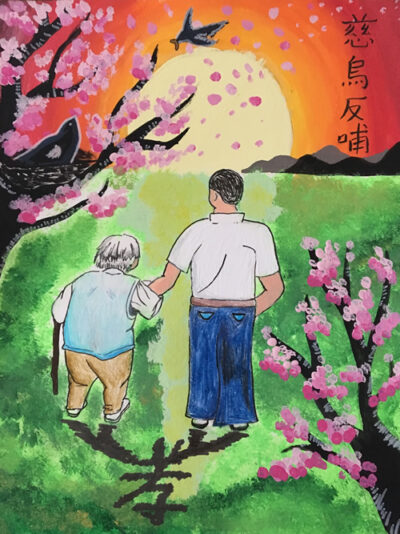
A’Tai (/ä’ tī/) noun. 1: Great Grandma
A memoir for my great-grand mom who I familiar but never yet to know.
You wondered if this is what she felt like when she died. Seizing your throat in an unyielding embrace – fluctuating breaths shoving fleshy skin in a wavering motion. The feeling of an asphyxiating object obstructing your windpipe; a manifestation of the news you received yesterday. But you did not feel it from the anguish of loss, but guilt – like a scrutinizing storm that washes all other emotions away and submerges you in itself.
You expected death. You braced for it. With such a harbinger as Covid – 19, spreading through the world like a hurricane, it made it a forecast – a divergence from usual unanticipated. Death, to you, should have been a horror movie; the rising fear that wells up in you until the proclamation – the fright of the jump scare. But you did not need to prepare for it. As your mother announced the news, a solemn gaze etched on the weary face, you felt nothing. Anticlimactic, you would assume. The fear came afterward, accompanied by the acidic and biting taste of guilt. You dreaded the empty feeling of your A’Tai’s passing that was not guided by sorrow – the unfelt loss of a human who has always loved you.
*
Your A’Tai, to you, was an affectionate and nurturing soul – like summer drizzles rinsing away the sweltering heat. The folded canvas that was her face was painted by hues of warm tones accompanied by cerulean shadows. You would know, for you tried to illustrate her for the departing, only to create an emulsion of colors you gave up on. But there’s a thing about summer rain. The dimming sky, coming as swift as lightning, was the only clue of its arrival, leaving in a snap of your fingers. The burning Earth cools down for a while, only to climb back again. The outdoors an aroma of freshly picked herbs, a touch tasteless yet with a tinge of sugar and a bittersweet hint. The next day your world returns to normal – few things affected, few things changed, and only a few saw it at all.
You don’t know much about A’Tai’s past. But in a time like hers, it must have been anything but blissful. And now, in the present, life, which already was brief, was shorter because you were late. In the end, you don’t know her. In a world of torrential downpour, A’Tai was summer rain, and you only arrived at its conclusion.
*
You were dressed in a purple shirt that day; a mix of red and blue. Red, like the cloth that enveloped her motionless body, and blue, like the cloudless sky that day. You wondered if the cover was similar to a tender hug or if it was strangling her; it felt like the latter. Clutching your shirt as if it was tantalizing, you subconsciously question why you didn’t know the funeral was today – you yearned to replace the color you donned. It was on your father’s phone – a video call parallel to the ones you do weekly, but the memory is hazy and obscure, for you were determined to omit most of it. However, you recall the thunder that jolts you from slumber; your father was weeping.
It was abrupt and shaky, pausing and returning, a cloudburst. And like squalls of storm clouds, your brother in correspondence, tears up too. But why couldn’t you do it too? Suddenly, you wished it was raining; it would have been more manageable to do the same.
*
In the days coming, fumes that emanated from incense crowded the house. The fragrance of candied sandalwood intertwined with ashy haze pushes through the storm clouds hung over your home. And like rain droplets benevolently roaming over rooftops, your mother’s keen reciting of scripture became background noise – something that saturated the paralyzing silence. There was an air of aggravation too. Tiptoeing past your father’s sullen spirit was an obligation, shown frequently in vegetarian dinners and provoking conversations.
The breaking of the clouds happens when your brother greets your relatives, in the weekly video call, with the phrase he’s echoed ever since we were born. Acknowledging each of them respectfully, he inadvertently addresses an absent one. A’Tai, a name that was evaded since the farewell was subsequently raised. The soaked ground finally dries up – the terminal step of swallowing the truth.
*
You were taught about the 5 stages of grief. You could see your family, each laboriously engrained in each one. Your brother’s denial, your father’s anger, and your mother’s bargaining. And you? Drowning in an unknown label, a tropical storm – the low pressure smothering everything else. Was it guilt? Or did you caper to tranquil acceptance, the aftermath of a downpour?
You were taught about feelings: joy, sorrow, anger, grief, regret, and guilt. They said they were straightforward and distinctive emotions; children’s picture book vocabulary. But the only definitions are synonyms, and, like how the Tempest rides the wind, is grief not regret, and regret, not guilt?
*
Perceptions of her face show in the filling spilled sweet rice balls a week after. Your shoulder shakes bitterly, for death can emerge from something that – meager. By gagging on it, you recall your father weakly mumbling. And then, while chewing the delicate rice ball, an understanding surfaces; you knew your grief was guilt, but why? It was because there was a space between you and her – and you wanted to be sheltered.
You expected death – her death, to be specific. By the time you’ve uncovered a judgment of life, age has already taken a toll on her. You assumed that getting closer would make it ache more. You were right, in a way. Now you’ve come to a point where you yearn to go outward to dance in that summer rain. But autumn has arrived, and they tell you that the drizzles you’ve watched from the window weekly won’t come back.
So why were you guilty? You’re guilty of not seeking to know her. Guilty, for all you felt, at the end of the storm…was guilt. Because you weren’t sure who the grief was for.
My Reflection:
My great-grandma inspired me to truly relish life as she was content with hers, no matter the struggle. One of my fondest memories of her was when my mother told me about the pain in her foot that she experiences every day. And yet, every day at 7, she would walk around the park to keep up with her health. The loss of her was more of a wake-up call. Living one ocean away from her always created a certain disconnection. To me, she forever will be that smiling woman that crochets scarves for me. That smiling woman that smells like musty flowers and leaves traces of the scent whenever she hugs me. But at her online funeral, I realized how much I didn’t know her. It impacted in a way of a sense of self-discovery and regret. I realized how weak the bonds that I tie myself with are. That month I just felt guilty for being so selfish. Selfish for not having anything to remember about my great-grandma. And, instead of strengthening those bonds, I shrunk further in the hole I dug myself in. I didn’t originally write this for the scholarship and instead for a diary. It began with recognition, trying to figure out the emotions that plagued me. A draining process that exhausted me mentally in ways I still do not understand. And then it transfigured into a hidden narrative about remembrance and most importantly, saying farewell. It made me move on and change. This year has given me a different judgment of relationships, one with a deeper cherishing of the present. It has given my current connections a different feeling, one of fleetingness yet hope, hope for remembrance.
This work is about my great-grandma, someone that has been with me throughout my whole life yet knew nothing about it. During the time after her funeral, I felt selfish for not being able to remember any about her distinctly, only a distant memory. This memoir began with recognition, trying to figure out the emotions that plagued me. And it turned into a narrative about remembrance and most importantly, saying farewell, cherishing the relationships of the present.
Golden-Key Award @ Regional | Silver-Key Award @ National
2022 Scholastic art and writing Competition (260,000 entries)