During my ASSIP research internship at George Mason University, I had the opportunity to attend a workshop (Unitar) organized by the United Nations Environment Programme (UNEP). One of the highlights of the first day of the workshop was an intriguing presentation by Pushpam Kumar, a member of UNEP, who gave a presentation on the limitations of Gross Domestic Product (GDP) as a measure of progress. As someone who has been exploring the world of data analysis with my FBLA competitive event, this sparked my curiosity and led me to delve deeper into the concept of moving beyond GDP and exploring alternative metrics that account for the value of nature and environmental impact.
Understanding the Shortcomings of GDP:
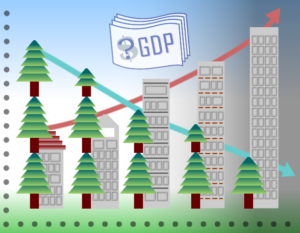
From the presentation and further research (UNEP, Beyond GDP: making nature count in the shift to sustainability), the problem that was introduced was that GDP falls short in capturing the full extent of nature’s contributions to the economy. While it considers tangible aspects such as market-based transactions, it overlooks the invaluable non-market benefits that nature provides, such as its spiritual, aesthetic, and recreational value. I also learned that GDP fails to account for the crucial role nature plays in supporting fundamental functions like the generation of fertile soil, the provision of clean air and water, and natural disease barriers. These oversights mask the underlying vulnerabilities of human well-being, even as financial incomes may seemingly rise. This realization strongly suggested the need for a more comprehensive approach to evaluating our long-term prosperity.
New Metrics for Sustainability:
In response to these limitations, economists have started developing alternative metrics that give a more holistic understanding of the health of our planet, people, and economic systems. One such metric that has piqued my interest is the Inclusive Wealth Index (IWI), which has been developed by UNEP. The IWI seeks to expand our perspective on sustainable development by incorporating the social value of economic, human, produced, and natural assets. It promises to provide a more comprehensive picture of our well-being and the health of our planet.
Concerns and Challenges:
As I delve further into my research, I encounter a range of concerns and challenges associated with the IWI and the broader concept of moving beyond GDP. Scholars have raised thought-provoking questions (Thiry and Roman, The Inclusive Wealth Index. A Sustainability Indicator, Really?) about the theoretical foundations of the IWI, particularly regarding the linkages between sustainability and well-being. Some critics challenge the validity of the so-called “equivalence theorem” that forms the basis of the IWI, suggesting a lack of compelling evidence to support its claims. Additionally, the IWI relies on data that is often scarce or difficult to obtain, making accurate assessments of social value and sustainability a challenging task.
Transboundary Pollution:
In the realm of environmental impact, the issue of transboundary pollution captures my attention. One of the questions I asked during the workshop was about the complexity of pollution that transcends national borders. The detrimental effects caused by one country’s actions on the environment of another country raise important questions about accountability and international cooperation. I did not receive a clear answer but I believe exploring how transboundary pollution can be incorporated into the assessment of well-being and sustainability becomes an intriguing avenue to explore further.
Historical Environmental Degradation:
Another compelling aspect that emerges during my research is the historical context of environmental degradation. Something that was brought up by another attendee was about the significant damage inflicted by past industrialization and unsustainable practices in many countries. This raises ethical questions about historical responsibility and the need for restoration efforts. Monitoring systems that track progress and measure the success of restoration initiatives seem essential to address the consequences of past environmental degradation. It brings up the question on whether historical events would be considered when monitoring IWI.
Conclusion:
As I continue to research the topic of beyond GDP and exploring alternative metrics for assessing wealth and environmental impact, I find myself both intrigued and humbled by the vastness of the topic. My early findings indicate the limitations of GDP and the potential of metrics like the Inclusive Wealth Index (IWI) to provide a more comprehensive understanding of our well-being and the state of our planet. However, as I continue to navigate through the research landscape, I encounter thought-provoking concerns regarding theoretical foundations, data availability, and the challenges of incorporating transboundary pollution and addressing historical environmental degradation. These concerns remind me of the complexity of the topic and the need for further investigation.